
|
DemoSat /
TestingCold testOn July 19, Jason Igo conducted our first cold test. He put the payload in a −80° F freezer for about 45 minutes, then left it on to drive home. He connected the heaters to a battery separate from that of the microcontroller. 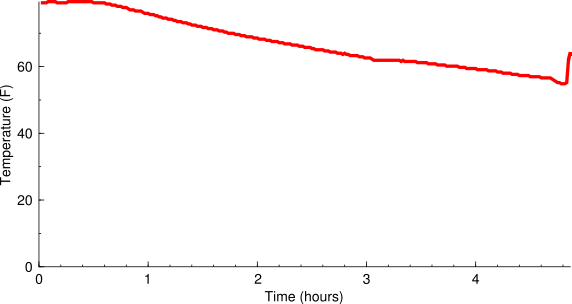 The heaters had stopped working by the end of the test. Somehow, some sectors of the memory card were damaged at about 9 MB, or 48 minutes. Consequently, there is no data from after the payload was removed from the freezer. In watching the rotation data that was recorded, we saw the rotation become wilder as time went on, more than could be explained from normal integration drift. This was a result of the rotation sensors changing their zero readings. This may have been caused by the change in temperature or by the battery losing power (we have observed before the gyro readings creeping slowly upward on a failing battery). Drop testThe drop test hasn't been done yet. Altitude/battery life testOn June 28, David Fifield took the FieldSat microcontroller and some of its sensors partway up a fourteener. A brand new 9 volt battery allowed it to record for more than seven hours before I switched it off. It recorded 79 MB of data at 100 samples per second. The pressure sensor has a narrow range of output voltages, which are turned by the ADC into only five discrete values! Nevertheless, by averaging successive samples, we can interpolate altitude data meaningfully. Using the formula for atmospheric pressure given at http://en.wikipedia.org/wiki/Atmospheric_pressure, I created the following graph: 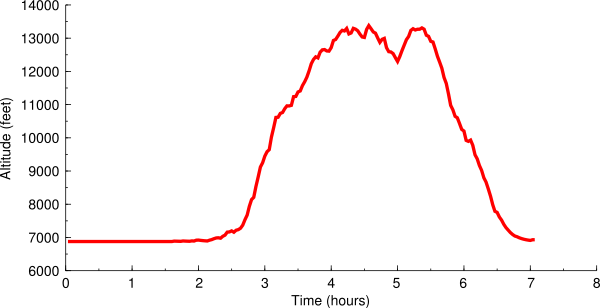 Because of the limited resolution of the pressure sensor, it is inaccurate until I started gaining elevation. (I actually started at about 11,000 feet, not 7,000.) After that, it matches what I did during the hike, including where I descended and then reascended to get around a large snowfield. |